Pages

Showing posts with label Kyushu. Show all posts

Thursday, January 31, 2019

Everything Japan Revival!

Hello everyone,

It's been about 8 months without any updates from my hiatus. I'm going to have this blog back and running around mid-February! Keep a look out for new posts.

flying-witch-gif-03.gif

Read On >>>

Monday, October 24, 2016

Dazaifu (大宰府)

Dazaifu (大宰府) was established in the late 7th century and served as the administrative center of the entire island of Kyushu for over 500 years. The city was built slightly inland from Hakata, whose port was one of the main points of interaction between Japan and mainland Asia. Although the imperial court ruled the country from the Kansai Region, Dazaifu was pivotal for Japan's diplomatic relations and organizing the country's defenses.

Tenman-gū shrine in Dazaifu
Nowadays, Dazaifu is a small, quiet city on the outskirts of the large city of Fukuoka, from which it is perfect for a day trip. There are a number of temples and shrines, the most famous of which is the Dazaifu Tenmangu Shrine, as well as sites related to Dazaifu's role as the region's administrative center, such as the Government Office Ruins. In 2005 the massive Kyushu National Museum was opened to the public, making a great new addition to the city's attractions.

Stone garden at Kōmyōzen-ji
Photos:
Read On >>>

Friday, July 15, 2016

Amanohashidate Sandbar

The Amanohashidate Sandbar (天橋立), is a beautiful, three kilometer long isthmus that spans the mouth of Miyazu Bay in northern Kyoto Prefecture. Amanohashidate roughly translates to "bridge in heaven", and it is said that the sandbar resembles a meandering pathway connecting heaven and earth when it is viewed from the mountains at either end of the bay. This famous view has been admired for centuries, and is counted among Japan's three most scenic views alongside Miyajima and Matsushima.


The narrow sandbar, which measures as little as 20 meters across at its narrowest point, is lined with nearly 8000 pine trees and is considered among Japan's finest pine tree spots. Some of the trees exhibit unique shapes and have been given names such as Meoto Matsu (Couples Pine), Nakayoshi no Matsu (Friendly Pine), and Chie no Matsu (Wisdom Pine).


Photo:

Read On >>>

Wednesday, May 11, 2016

Yakushima (屋久島)

Yakushima (屋久島) is a subtropical island off the southern coast of Kyushu and part of Kagoshima Prefecture. It is covered by an extensive cedar forest that contains some of Japan's oldest living trees. Trees more than 1000 years old are affectionately called yakusugi (a combination of Yakushima and sugi, the Japanese word for cedar), the most ancient of which may be over 7000 years old.


The island's cedar forests were logged extensively in the past, particularly during the Edo Period for the production of cedar shingles. Today the forests have well recovered from past logging and are a national park, while some areas were declared a Natural World Heritage Site in 1993. Most tourists come to the island to hike through the forests and see the ancient cedar trees.

As a subtropical island with nearly 2000 meter high mountains, Yakushima attracts a lot of rainfall around the year, with a local saying claiming that it rains "35 days a month". While that may be an exaggeration, there is some rain almost on a daily basis, especially in the mountainous interior, although the rain can also be light and limited to short periods of time. In higher elevations the precipitation falls as snow during the winter months.


Photos:

Read On >>>

Wednesday, September 9, 2015

Kuju Mountain (九重山)

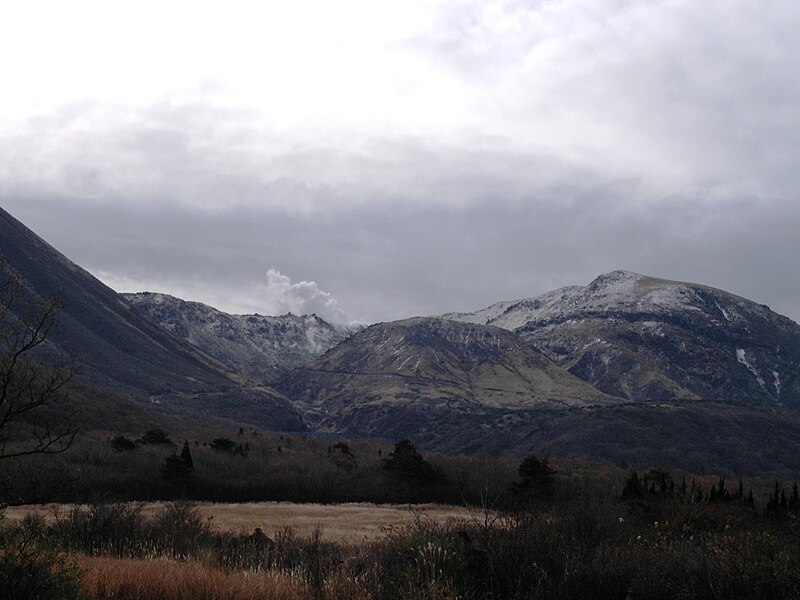
The Kuju mountain range (九重山) is part of the Aso-Kuju National Park and includes the highest peak on the island of Kyushu. The mountains are covered by a network of hiking trails that offer spectacular views of the volcanic terrain. Between late October and mid November, Kuju becomes one of the best places on Kyushu to find fall colors.


The Kuju mountains are located along the Yamanami Highway that extends from Beppu to Aso as part of the attractive Trans Kyushu Route. The two main trailheads for the Kuju mountains are located at the Makinoto Pass and the Chojabaru Visitor Center, which are both along the popular road.

Of the park's two main trailheads, the Makinoto Pass is located at a higher elevation and is closer to the main mountain peaks, while the Chojabaru Visitor Center has informative displays about the area and more facilities. Depending on the trailhead and route taken, a round trip to Kuju's main peaks typically takes between four and six hours.

The park's highest point is the Nakadake (中岳) peak, which stands at 1791 meters. The nearby Kuju (久住山) peak stands slightly shorter at 1786 meters and is popular for its fantastic views. Another popular peak to visit is Hossho (星生山), which has steam emitting vents along its slopes. The peaks of the Kuju mountains are usually covered in snow from December through March.


Photos:

"Makinoto Pass - 01" by JKT-c - Own work. Licensed under CC BY 3.0 via Commons - https://commons.wikimedia.org/wiki/File:Makinoto_Pass_-_01.jpg#/media/File:Makinoto_Pass_-_01.jpg

"Kuju Mountains 03" by Reggaeman - Own work. Licensed under CC BY-SA 3.0 via Commons - https://commons.wikimedia.org/wiki/File:Kuju_Mountains_03.JPG#/media/File:Kuju_Mountains_03.JPG

"Kuju04" by Mass Ave 975 - Taken by Mass Ave 975. Licensed under CC BY-SA 3.0 via Commons - https://commons.wikimedia.org/wiki/File:Kuju04.JPG#/media/File:Kuju04.JPG
Read On >>>