Pages

Showing posts with label Kyoto. Show all posts

Wednesday, February 20, 2019

Hanatoro (花灯路)

Hanatoro (花灯路), which means "flower and light road", is a set of illumination events that take place in the Higashiyama District of Kyoto in March and the Arashiyama district of Kyoto in December. During Hanatoro the streets are illuminated by thousands of lanterns set throughout popular areas combined with flower and light displays.


Many temples and shrines are illuminated and have special extended viewing hours. In addition, live and street performances are held at stages around the area. The pleasant and unique atmosphere of Hanatoro attracts many visitors who can stroll the streets and see a different side of Kyoto.


Read On >>>

Monday, February 26, 2018

Gion (祇園)

Gion (祇園) is Kyoto's most famous geisha district, located around Shijo Avenue between Yasaka Shrine in the east and the Kamo River in the west. It is filled with shops, restaurants and ochaya (teahouses), where geiko (Kyoto dialect for geisha) and maiko (geiko apprentices) entertain.

Gion attracts tourists with its high concentration of traditional wooden machiya merchant houses. Due to the fact that property taxes were formerly based upon street frontage, the houses were built with narrow facades only five to six meters wide, but extend up to twenty meters in from the street.


Read On >>>

Saturday, August 26, 2017

Kinkakuji (金閣寺)

Kinkakuji (金閣寺) is a Zen temple in northern Kyoto whose top two floors are completely covered in gold leaf. Formally known as Rokuonji, the temple was the retirement villa of the shogun Ashikaga Yoshimitsu, and according to his will it became a Zen temple of the Rinzai sect after his death in 1408. Kinkakuji was the inspiration for the similarly named Ginkakuji (Silver Pavilion), built by Yoshimitsu's grandson, Ashikaga Yoshimasa, on the other side of the city a few decades later.

Kinkakuji 2004-09-21.jpg

Kinkakuji is an impressive structure built overlooking a large pond, and is the only building left of Yoshimitsu's former retirement complex. It has burned down numerous times throughout its history including twice during the Onin War, a civil war that destroyed much of Kyoto; and once again more recently in 1950 when it was set on fire by a fanatic monk. The present structure was rebuilt in 1955.


Read On >>>

Friday, January 6, 2017

Aoi Matsuri (葵祭)

The Aoi Matsuri (葵祭) is one of the three main annual festivals held in Kyoto, Japan, the other two being the Festival of the Ages (Jidai Matsuri) and the Gion Festival. It is a festival of the two Kamo shrines in the north of the city, Shimogamo Shrine and Kamigamo Shrine. The festival may also be referred to as the Kamo Festival. It is held on 15 May of each year.


The festival originated during the reign of Emperor Kinmei (reigned CE 539 - 571). The ancient records known as the Honchō getsurei (本朝月令) and Nenchūgyōji hissho (年中行事秘抄) reveal that a succession of disastrous rains with high winds ruined the grain crops, and epidemics had spread through the country. Because diviners placed the cause on divine punishment by the Kamo deities, the Emperor sent his messenger with a retinue to the shrine to conduct various acts to appease the deities, in prayer for a bountiful harvest. These included riding a galloping horse.


Photos:

Read On >>>

Friday, September 30, 2016

Kiyomizudera (清水寺)

Kiyomizudera (清水寺) is one of the most celebrated temples of Japan. It was founded in 780 on the site of the Otowa Waterfall in the wooded hills east of Kyoto, and derives its name from the fall's pure waters. The temple was originally associated with the Hosso sect, one of the oldest schools within Japanese Buddhism, but formed its own Kita Hosso sect in 1965. In 1994, the temple was added to the list of UNESCO world heritage sites.

Kiyomizu.jpg

Kiyomizudera is best known for its wooden stage that juts out from its main hall, 13 meters above the hillside below. The stage affords visitors a nice view of the numerous cherry and maple trees below that erupt in a sea of color in spring and fall, as well as of the city of Kyoto in the distance. The main hall, which together with the stage was built without the use of nails, houses the temple's primary object of worship, a small statue of the eleven faced, thousand armed Kannon.


Kiyomizu-dera

Photos:

"Kiyomizu" by Jordy Meow - Own work. Licensed under CC BY-SA 3.0 via Commons - https://commons.wikimedia.org/wiki/File:Kiyomizu.jpg#/media/File:Kiyomizu.jpg

"Kyoto-Kiyomizu Temple-2" by Christopher Mann McKay at English Wikipedia. Licensed under CC BY 2.5 via Commons - https://commons.wikimedia.org/wiki/File:Kyoto-Kiyomizu_Temple-2.JPG#/media/File:Kyoto-Kiyomizu_Temple-2.JPG

"Kiyomizu-dera in Kyoto-r" by Oilstreet - Oilstreet. Licensed under CC BY 2.5 via Commons - https://commons.wikimedia.org/wiki/File:Kiyomizu-dera_in_Kyoto-r.jpg#/media/File:Kiyomizu-dera_in_Kyoto-r.jpg
Read On >>>

Friday, July 15, 2016

Amanohashidate Sandbar

The Amanohashidate Sandbar (天橋立), is a beautiful, three kilometer long isthmus that spans the mouth of Miyazu Bay in northern Kyoto Prefecture. Amanohashidate roughly translates to "bridge in heaven", and it is said that the sandbar resembles a meandering pathway connecting heaven and earth when it is viewed from the mountains at either end of the bay. This famous view has been admired for centuries, and is counted among Japan's three most scenic views alongside Miyajima and Matsushima.


The narrow sandbar, which measures as little as 20 meters across at its narrowest point, is lined with nearly 8000 pine trees and is considered among Japan's finest pine tree spots. Some of the trees exhibit unique shapes and have been given names such as Meoto Matsu (Couples Pine), Nakayoshi no Matsu (Friendly Pine), and Chie no Matsu (Wisdom Pine).


Photo:

Read On >>>

Thursday, June 2, 2016

Hanatoro (花灯路)

Hanatoro (花灯路), which means "flower and light road", is a set of illumination events that take place in the Higashiyama District of Kyoto in March and the Arashiyama district of Kyoto in December. During Hanatoro the streets are illuminated by thousands of lanterns set throughout popular areas combined with flower and light displays.


Many temples and shrines are illuminated and have special extended viewing hours. In addition, live and street performances are held at stages around the area. The pleasant and unique atmosphere of Hanatoro attracts many visitors who can stroll the streets and see a different side of Kyoto.


Photos:


Read On >>>

Friday, March 25, 2016

Kyoto Station (京都駅)

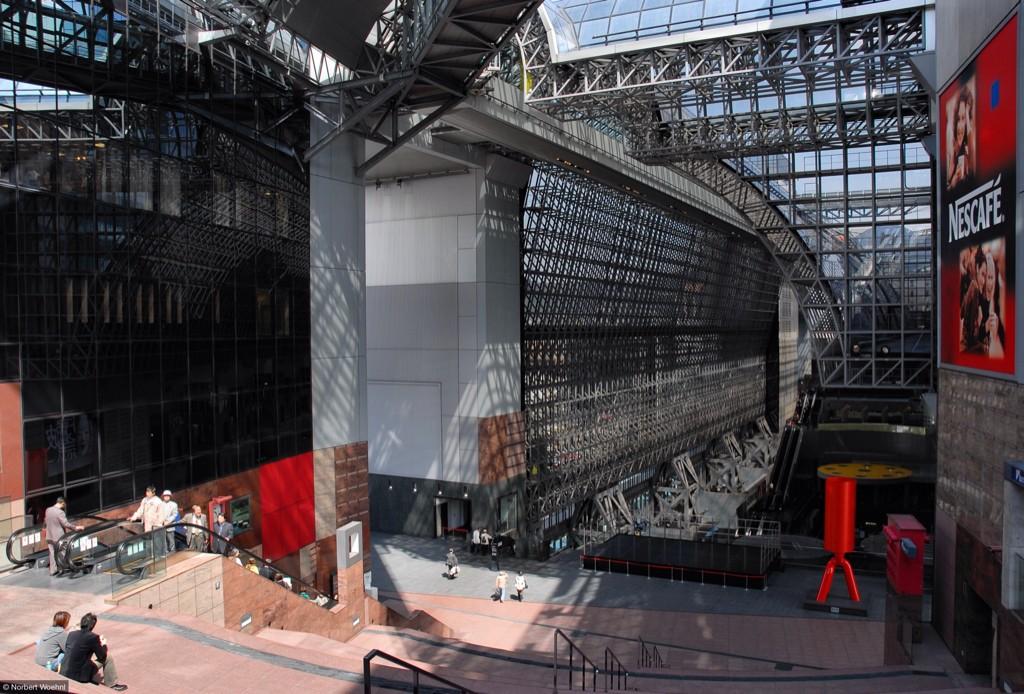
Kyoto Station (京都駅) is a major railway station and transportation hub in Kyoto, Japan. It has Japan's second-largest station building (after Nagoya Station) and is one of the country's largest buildings, incorporating a shopping mall, hotel, movie theater, Isetan department store, and several local government facilities under one 15-story roof. It also housed the Kyoto City Air Terminal until August 31, 2002.

Embedded image permalink
Read On >>>

Sunday, December 27, 2015

The Kyoto Imperial Palace (京都御所)

The Kyoto Imperial Palace (京都御所) used to be the residence of Japan's Imperial Family until 1868, when the emperor and capital were moved from Kyoto to Tokyo. It is located in the spacious Kyoto Imperial Park (京都御苑), an attractive park in the center of the city that also encompasses the Sento Imperial Palace and a few other attractions.


The current Imperial Palace was reconstructed in 1855 after it had burnt down and moved around town repeatedly over the centuries. The complex is enclosed by long walls and consists of several gates, halls and gardens. The enthronement ceremonies of Emperors Taisho and Showa were still held in the palace's main hall, but the present Emperor's ceremony took place at the Tokyo Imperial Palace.
The palace grounds can be entered only on guided tours (in English or Japanese) held by the Imperial Household Agency. Tours take about one hour and lead past the buildings and gardens, but none of the buildings can be entered. Advance reservations are mandatory and can be made online or at the Imperial Agency Office, which is also located within the Kyoto Imperial Park.


京都御所は皇帝と資本が東京に京都から移動した1868年まで、日本の皇室の住居に使用されます。これは、広々とした京都帝国公園、また仙洞御所といくつかの他の観光スポットを網羅街の中心部にある魅力的な公園内に位置しています。
それが焼失し、何世紀にもわたって繰り返し街を移動した後に、現在の皇居は、 1855年に再建されました。複合体は、長い壁で囲まれ、いくつかのゲート、ホールや庭園で構成されています。皇帝大正·昭和の即位の儀式はまだ宮殿のメインホールで開催されましたが、本天皇の式典が皇居で行われました。
宮殿の敷地のみ宮内庁が保持している(日本語または英語)のガイド付きツアーに入力することができます。ツアーは約1時間を取ると、建物や庭園を過ぎつながるが、建物はどれも入力できません。予約が必須で、オンラインまたはも京都帝国公園内に位置するインペリアル庁オフィス、で行うことができ進めます。

Photos:

"Seiryoden" by Wikiwikiyarou - Own work. Licensed under CC BY 3.0 via Wikimedia Commons - https://commons.wikimedia.org/wiki/File:Seiryoden.jpg#/media/File:Seiryoden.jpg

"Imperial Palace in Kyoto - looking into south gate of main building 3" by Ryuch - Own work. Licensed under CC BY-SA 3.0 via Wikimedia Commons - https://commons.wikimedia.org/wiki/File:Imperial_Palace_in_Kyoto_-_looking_into_south_gate_of_main_building_3.JPG#/media/File:Imperial_Palace_in_Kyoto_-_looking_into_south_gate_of_main_building_3.JPG

Read On >>>

Monday, October 12, 2015

Fushimi Inari Shrine (伏見稲荷大社)

Fushimi Inari Shrine (伏見稲荷大社) is an important Shinto shrine in southern Kyoto. It is famous for its thousands of vermilion torii gates, which straddle a network of trails behind its main buildings. The trails lead into the wooded forest of the sacred Mount Inari, which stands at 233 meters and belongs to the shrine grounds.


Fushimi Inari is the most important of several thousands of shrines dedicated to Inari, the Shinto god of rice. Foxes are thought to be Inari's messengers, resulting in many fox statues across the shrine grounds. Fushimi Inari Shrine has ancient origins, predating the capital's move to Kyoto in 794.


At the very back of the shrine's main grounds is the entrance to the torii gate covered hiking trail, which starts with two dense, parallel rows of gates called Senbon Torii ("thousands of torii gates"). The torii gates along the entire trail are donations by individuals and companies, and you will find the donator's name and the date of the donation inscribed on the back of each gate. The cost starts around 400,000 yen for a small sized gate and increases to over one million yen for a large gate.

Photos:

"Toris inari 7" by Dariusz Jemielniak ("Pundit") - Own work. Licensed under CC BY-SA 3.0 via Commons - https://commons.wikimedia.org/wiki/File:Toris_inari_7.jpg#/media/File:Toris_inari_7.jpg

"Inari sculpture" by Dariusz Jemielniak ("Pundit") - Own work. Licensed under CC BY-SA 3.0 via Commons - https://commons.wikimedia.org/wiki/File:Inari_sculpture.jpg#/media/File:Inari_sculpture.jpg

"Inari fountain" by Dariusz Jemielniak ("Pundit") - Own work. Licensed under CC BY-SA 3.0 via Commons - https://commons.wikimedia.org/wiki/File:Inari_fountain.jpg#/media/File:Inari_fountain.jpg
Read On >>>

Wednesday, April 22, 2015

Byodoin Temple (平等院)


Byodoin Phoenix Hall Uji 2009.jpg


Byodoin Temple (平等院) is a striking example of Buddhist Pure Land (Jodo) architecture. Together with its garden, the temple represents the Pure Land Paradise and was influential on later temple construction. Byodoin was initially built in 998 as a countryside retreat villa for the powerful politician Fujiwara no Michinaga, not as a temple.


Michinaga's son turned Byodoin into a temple and ordered the construction of its most spectacular feature, the Phoenix Hall. Although the building was given another official name, almost immediately after its construction in 1053, it was nicknamed Hoodo ("Phoenix Hall") because of its shape and the two phoenix statues on its roof. The hall is now featured on the back of the Japanese ten yen coin.


平等院は仏教浄土建築の顕著な例である。一緒にその庭と、寺院は浄土パラダイスを表し、後に神殿の建設に影響を与えた。平等院は最初ではない寺として、強力な政治家の藤原田舎の隠れ家ヴィラとして998ノー道長を建てなかった。

道長の息子が神殿に平等院を向け、その最も壮観な機能、フェニックスホールの建設を命じた。建物は1053年に建設した後ほぼすぐに別の正式名称を、与えられたが、それは、その形状とその屋根に2フェニックスの彫像のフェニックスホールを愛称で呼ばれた。会場は、現在日本の10円硬貨の裏面に紹介されています。

Photos:

"Byodoin Phoenix Hall Uji 2009" by 663highland - Own work. Licensed under CC BY 2.5 via Wikimedia Commons - https://commons.wikimedia.org/wiki/File:Byodoin_Phoenix_Hall_Uji_2009.jpg#/media/File:Byodoin_Phoenix_Hall_Uji_2009.jpg

"Byodoin-PhoenixHall-M1264". Licensed under Public Domain via Wikimedia Commons - https://commons.wikimedia.org/wiki/File:Byodoin-PhoenixHall-M1264.jpg#/media/File:Byodoin-PhoenixHall-M1264.jpg
Read On >>>

Monday, April 13, 2015

Kyoto International Manga Museum (京都国際マンガミュージアム)

The Kyoto International Manga Museum (京都国際マンガミュージアム) was opened in November of 2006. It consists of three floors and a basement, and most of its walls are lined with shelves of manga. Browsing this massive collection of manga is one of the museum's main attractions. A small section of the books is dedicated to foreign and translated manga, but the vast majority is in Japanese.


In addition to its massive collection of indigenous manga, the museum also focuses on both the adoption and development of manga internationally. Works of international manga artists are featured, and manga related events at the museum often involve foreign artists.

In addition to its permanent collection, the Manga Museum also features temporary exhibitions on various themes. The building, which now acts as the Manga Museum, was previously an elementary school. Some relics of the former school are on display for visitors.


京都国際マンガミュージアムは、それが3階と地下で構成されて、2006年の11月にオープンした、とその壁のほとんどが漫画の棚が並んでいます。漫画のこの膨大なコレクションをブラウズすることは博物館の主要観光名所のひとつです。本の小さなセクションには、外国の翻訳漫画に捧げられていますが、大半は日本語である。

先住民族漫画のその膨大なコレクションに加えて、博物館はまた採用と国際的に漫画の発展の両方をオン焦点を当てています。国際マンガ家の作品が紹介され、そして博物館で漫画関連のイベントは、多くの場合、海外のアーティストを伴う。

そのパーマネントコレクションに加えて、マンガミュージアムはまた、様々なテーマでの一時的な展覧会を備えています。今マンガミュージアムとして機能する建物は、以前に小学校だった。前の学校の一部の遺物は、訪問者のための展示されています。

Photos:

"京都国際マンガミュージアム" by 珈琲ルンバ from ja. Licensed under CC BY-SA 3.0 via Wikimedia Commons - https://commons.wikimedia.org/wiki/File:%E4%BA%AC%E9%83%BD%E5%9B%BD%E9%9A%9B%E3%83%9E%E3%83%B3%E3%82%AC%E3%83%9F%E3%83%A5%E3%83%BC%E3%82%B8%E3%82%A2%E3%83%A0.jpg#/media/File:%E4%BA%AC%E9%83%BD%E5%9B%BD%E9%9A%9B%E3%83%9E%E3%83%B3%E3%82%AC%E3%83%9F%E3%83%A5%E3%83%BC%E3%82%B8%E3%82%A2%E3%83%A0.jpg

"Kyoto International Manga Museum - Main Exhibit" by Kento Ikeda - originally posted to Flickr as Kyoto International Manga Museum - Main Exhibit. Licensed under CC BY 2.0 via Wikimedia Commons - https://commons.wikimedia.org/wiki/File:Kyoto_International_Manga_Museum_-_Main_Exhibit.jpg#/media/File:Kyoto_International_Manga_Museum_-_Main_Exhibit.jpg
Read On >>>

Sunday, March 8, 2015

Deer in Nara (奈良市)

Nara (奈良市) is the capital city of Nara Prefecture located in the Kansai region of Japan. The city occupies the northern part of Nara Prefecture, bordering Kyoto Prefecture. Eight temples, shrines and ruins in Nara remain, together with Kasugayama Primeval Forest, collectively form "Historic Monuments of Ancient Nara", a UNESCO World Heritage Site.

According to the legendary history of Kasuga Shrine, a mythological god Takemikazuchi arrived in Nara on a white deer to guard the newly built capital of Heijō-kyō. Since then the deer have been regarded as heavenly animals, protecting the city and the country.

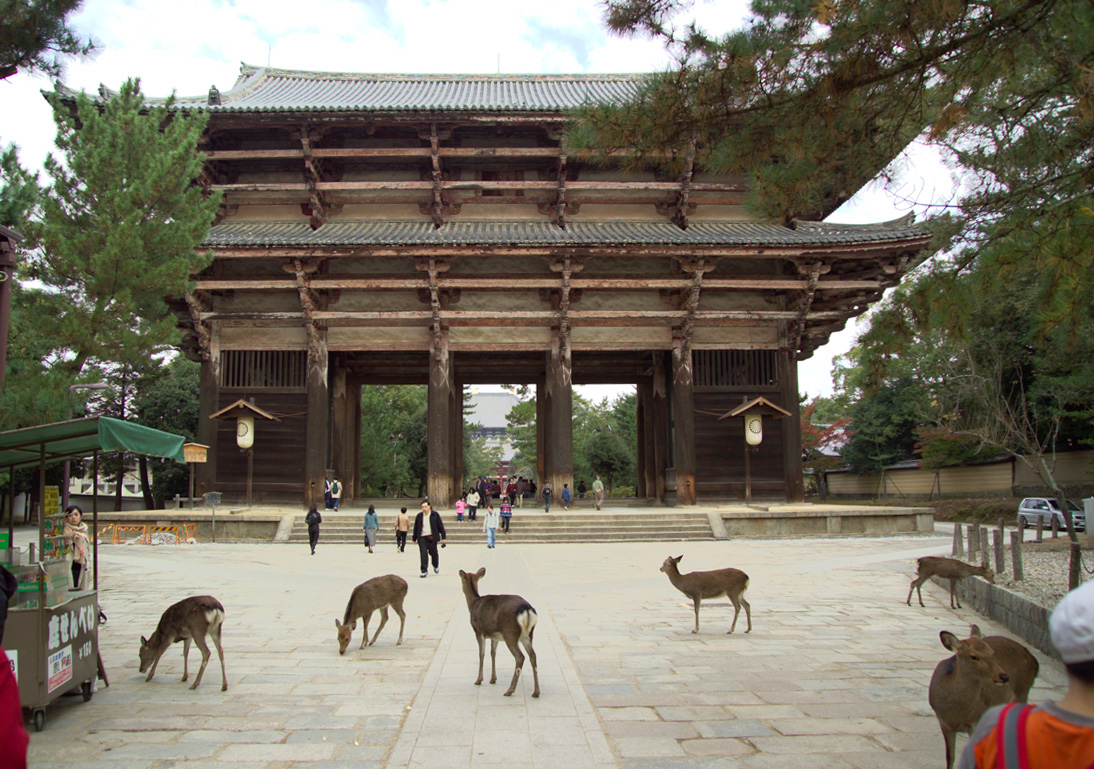
Tame Shika deer roam through the town, especially in Nara Park. Snack vendors sell "shika sembei" (deer biscuits) to visitors so they can feed the deer.

If you bow to the deer, especially in Nara Park, the deer will bow to you. They may even bow without being bowed to.
Deer roaming in Nara Park in autumn.


奈良は日本の関西地方に位置する奈良県の首都です。市は京都府に隣接する奈良県の北部を占める。エイトの寺院、神社や奈良の遺跡が総称して「古都奈良の文化財」 、ユネスコの世界遺産を形成し、一緒に春日山原始林で、残っている。


春日神社の伝説的な歴史によると、神話の神建御雷は平城京の新しく建てられた首都を守るために白い鹿に奈良に到着した。それ以来、鹿は都市と国を守る、天の動物としてみなされてきた。

タメ志賀の鹿は、特に奈良公園で、町を歩き回る。彼らは鹿を養うことができるようにスナックベンダーは訪問者に「志賀せんべい」 (鹿のビスケット)を販売しています。

あなたが特に奈良公園で鹿にお辞儀をした場合、鹿はあなたにお辞儀をします。彼らもにお辞儀されずに弓があります。


Read On >>>