Pages

Showing posts with label Japanese Festival. Show all posts

Thursday, January 31, 2019

Everything Japan Revival!

Hello everyone,

It's been about 8 months without any updates from my hiatus. I'm going to have this blog back and running around mid-February! Keep a look out for new posts.

flying-witch-gif-03.gif

Read On >>>

Wednesday, March 28, 2018

Sanja Matsuri (三社祭)

Sanja Matsuri (三社祭) is one of the three great Shinto festivals in Tokyo. It is considered one of the wildest and largest. The festival is held in honor of Hinokuma Hamanari, Hinokuma Takenari and Hajino Nakatomo, the three men who established and founded Sensō-ji. Sanja Matsuri is held on the third weekend of every May at Asakusa Shrine. Its prominent parades revolve around three mikoshi (three portable shrines referenced in the festival's name), as well as traditional music and dancing. Over the course of three days, the festival attracts 1.5 to 2 million locals and tourists every year.


三社祭は、 (三社祭)東京の三大神社祭りの一つです。これは、野生のの1と最大と考えられている。祭りはHinokuma Hamanari 、 Hinokuma TakenariとHajino Nakatomo 、設立され、浅草寺に設立3人の名誉で開催されている。三社祭は浅草神社で毎年5月の第三週末に開催されている。その顕著なパレードは約3神輿(祭りの名前で参照されている3神輿)だけでなく、伝統的な音楽や踊りを中心に展開。 3日間にわたって、祭りは1.5から2000000地元の人や観光客が毎年訪れます。
Read On >>>

Friday, January 26, 2018

Kanto Matsuri (竿燈まつり)

The Kanto Matsuri (竿燈まつり) is a Tanabata related celebration in Akita City, held every year from August 3 to 6. The highlight of the festival is an impressive display of skill in which performers balance kanto (long bamboo poles) with arrays of paper lanterns attached to the end. The Kanto Matsuri together with Aomori's Nebuta Festival and Sendai's Tanabata makes up the three great festivals of the Tohoku Region.


The kanto poles come in different sizes with the largest measuring 12 meters, weighting 50 kilograms and carrying as many as 46 paper lanterns, lit by real candles. To the sound of drums, flutes and onlookers chanting "dokkoisho, dokkoisho", each kanto is hoisted up by a single performer who balance them on end using various techniques. The performers change every few minutes and gradually add extensions to the pole until the kanto are at their maximum height.


The main event of the festival, the Night Parades, are held nightly along Chuo Dori street in the center of the city. The various performing groups, carrying nearly 250 kanto poles, line up on the street, and when a signal is given, the poles are all raised up at once and the performers show off their skills. The event lasts about 90 minutes, and at the end of each night there is a 15 minute session during which the audience is invited to talk to the performers, take pictures and try their hand at hoisting up a kanto.
Read On >>>

Saturday, January 20, 2018

Otaru Snow Light Path Festival (小樽雪あかりの路)

The Otaru Snow Light Path Festival (小樽雪あかりの路) is a winter festival held every February in Otaru, during which the city becomes decorated in lights and small snow statues for ten days. The festival usually runs at the same time as the nearby Sapporo Snow Festival, making it possible for travelers in Hokkaido to visit both festivals on the same trip.


The combination of the snowy town and the glittering lanterns creates a very pleasant atmosphere. There are two main official festival areas which get lit up daily from 17:00 to 21:00: the Unga Kaijo area and the Temiyasen Kaijo area. In addition, many locals also put lantern displays in front of their shops and residences, which further adds to the festival spirit. The two main areas are both located within a fifteen minute walk of the train station, so travelers can easily enjoy the town's atmosphere on foot.


Read On >>>

Thursday, January 11, 2018

Nagasaki Kunchi

The Nagasaki Kunchi is the festival of Suwa Shrine, held annually in Nagasaki on October 7-9. The festival has been celebrated for about 400 years and incorporates different aspects of Chinese and Dutch cultures, which have played a role in the city's history. The festival's name is believed to come from ku-nichi ("9th day"), the ninth day of the ninth month of the lunar calendar.

The festival's highlight are dance and show performances by groups representing Nagasaki's various city districts. Each district (odori-cho), participates only once every seven years, so this festival remains fresh to even the regular viewer.


About five to seven groups perform each year, presenting traditional Japanese dances, Chinese influenced dragon dances or performances involving large floats, many of which are shaped like ships. While some performances are calm and peaceful, others get wild and hectic.

Performances are held at four main venues with paid seating and/or standing areas in the morning and evening of October 7 and in the mornings of October 8 and 9. The four main stages are Suwa Shrine, Otabisho, Yasaka Shrine, and Kokaido.


Photos;
Read On >>>

Monday, January 1, 2018

Fukubukuro (福袋)

Fukubukuro (福袋) is a Japanese New Year custom in which merchants make grab bags filled with unknown random contents and sell them for a substantial discount, usually 50% or more off the list price of the items contained within. The low prices are usually done to attract customers to shop at that store during the new year. The term is formed from Japanese fuku (福, meaning "good fortune") and fukuro (袋, meaning "bag"). The fuku comes from the Japanese saying that "there is fortune in leftovers."

Popular stores' fukubukuro usually are snapped up quickly by eager customers, with some stores having long lines snake around city blocks hours before the store opens on New Year's Day. Fukubukuro are an easy way for stores to unload excess and unwanted merchandise from the previous year, due to a Japanese superstition that one must not start the New Year with unwanted trash from the previous year and start clean. Nowadays, some fukubukuro are pushed as a lavish New Year's event, where the contents are revealed beforehand, but this practice is criticized as just a renaming of selling things as sets.


Read On >>>

Saturday, December 16, 2017

Okonomiyaki

Okonomiyaki is a popular pan fried food that consists of batter and cabbage. Selected toppings and ingredients are added which can vary greatly (anything from meat and seafood to wasabi and cheese). This variability is reflected in the dish's name; "okonomi" literally means "to one's liking". The dish is available all over Japan, but is most popular in the west, particularly the cities of Hiroshima and Osaka.


Okonomiyaki is sometimes translated into English as "As-you-like-it Pancake". However, this may be misleading. Though it does consist of batter cooked on a griddle, okonomiyaki has nothing of the sweetness or fluffiness of pancakes, not to mention that it is usually filled with octopus, shrimp, pork, yam or kimchi. A more accurate comparison, which is also made, is between okonomiyaki and pizza.

In Japan, people usually eat okonomiyaki at restaurants that specialize in the dish. At some of these restaurants the dining tables are each equipped with an iron griddle ("teppan"), and customers are given the ingredients to cook the meal themselves. As this can be rather daunting, the stages of cooking are enumerated below. Information about regional variations can be found thereafter.


Read On >>>

Monday, December 4, 2017

Sanno Matsuri

The Sanno Matsuri is one of the three most famous festivals of Tokyo, along the Kanda Matsuri and Fukagawa Matsuri. It takes place in mid June in even numbered years, alternating with the Kanda Matsuri which takes place in odd numbered years. The Sanno Festival extends over a week and has a few events, but most of them are rather small.


The festival's main attraction is a parade that winds through central Tokyo over the course of nine hours on one of the festival days. The parade begins and ends at Hie Shrine, the shrine responsible for holding the festival. Hie Shrine enshrines the guardian deity of Tokyo. It is believed to predate the foundation of the city, and its kami (Shinto gods) have always been associated with the protection of the city.


At Hie Shrine, where the parade begins in the morning, visitors can find a large straw ring standing in the middle of the shrine grounds. Walking through the ring is an act of purification in which visitors can take part. The parade gradually winds its way around the area, passing by the Yotsuya train station and Yasukuni Shrine. Before noon the parade arrives at the Tokyo Imperial Palace and stops for about half an hour while the mikoshi are involved in religious ceremonies. The chief priest enters the palace to offer prayers to the emperor and imperial family, which is a rare honor afforded to the festival.


Read On >>>

Friday, January 6, 2017

Aoi Matsuri (葵祭)

The Aoi Matsuri (葵祭) is one of the three main annual festivals held in Kyoto, Japan, the other two being the Festival of the Ages (Jidai Matsuri) and the Gion Festival. It is a festival of the two Kamo shrines in the north of the city, Shimogamo Shrine and Kamigamo Shrine. The festival may also be referred to as the Kamo Festival. It is held on 15 May of each year.


The festival originated during the reign of Emperor Kinmei (reigned CE 539 - 571). The ancient records known as the Honchō getsurei (本朝月令) and Nenchūgyōji hissho (年中行事秘抄) reveal that a succession of disastrous rains with high winds ruined the grain crops, and epidemics had spread through the country. Because diviners placed the cause on divine punishment by the Kamo deities, the Emperor sent his messenger with a retinue to the shrine to conduct various acts to appease the deities, in prayer for a bountiful harvest. These included riding a galloping horse.


Photos:

Read On >>>

Monday, November 21, 2016

Shichi-Go-San (七五三)

Shichi-Go-San (七五三) is a traditional rite of passage and festival day in Japan for three- and seven-year-old girls and three- and five-year-old boys, held annually on November 15 to celebrate the growth and well-being of young children. As it is not a national holiday, it is generally observed on the nearest weekend.


The tradition has changed little since the Meiji period. While the ritual regarding hair has been discarded, boys who are aged three or five and girls who are aged three or seven are still dressed in kimono—many for the first time—for visits to shrines. Three-year-old girls usually wear hifu (a type of padded vest) with their kimono. Western-style formal wear is also worn by some children.


A more modern practice is photography, and this day is well known as a day to take pictures of children. Some families observe the rite based on the traditional way of calculating age, or kazoedoshi, in which children are one year old at birth and gain a year on each Lunar New Year.


Photos:
Image Source
Image Source
Image Source
Read On >>>

Sunday, November 13, 2016

Yatai (屋台)

Fukuoka's open air food stands (屋台) are possibly the city's best known symbol. Yatai can generally seat about seven or eight people and provide an atmospheric outdoor environment to enjoy various foods that are generally simple and filling. There are over 150 yatai scattered across Fukuoka but the best place to find them is on the southern end of Nakasu Island. Located in the middle of the city, Nakasu Island has a long row of around 20 yatai that are attractively situated along the water.


Typical dishes enjoyed at yatai are grilled chicken skewers (yakitori), hot pot (oden) and most famously Hakata Ramen, a local noodle dish featuring relatively thin ramen noodles in a pork bone based soup (tonkotsu). Various alcoholic drinks are also available, and help make the yatai a great place to get in touch with the locals, although many of the "locals" happen to be Japanese tourists visiting Fukuoka from other parts of Japan.


Yatai are typically open from around 6pm to around 2am, except when the weather is very bad. Many stands close one day of the week. The closure day varies from stand to stand, but is often Sunday. There can be waiting times for popular stands, especially on Fridays and Saturdays.


Photos:
Read On >>>

Monday, September 26, 2016

Tenjin Festival (天神祭)

The Tenjin Festival (天神祭) of Osaka is ranked as one of Japan's top three festivals, along with the Gion Matsuri of Kyoto and the Kanda Matsuri of Tokyo. The festival started in the 10th century and today takes place on July 24 and 25 every year. The main celebrations are held on the festival's second day, July 25, including a land procession and a river procession with fireworks.


Tenjin Matsuri is the festival of the Tenmangu Shrine and honors its principle deity Sugawara Michizane, the deity of scholarship. The festival begins by ceremonially inviting the deity out of the shrine and parading him through the city, carrying out various exuberant festivities to entertain him, before taking him back to the shrine. For the people, the lively festivities manifest in a wonderful occasion to enjoy the hot summer day, filled with traditional costumes, spectacular processions and a celebratory atmosphere.


Photos:

"120725 Osaka Tenjinmatsuri Japan08bs" by 663highland - 投稿者自身による作品. Licensed under CC 表示 2.5 via ウィキメディア・コモンズ - https://commons.wikimedia.org/wiki/File:120725_Osaka_Tenjinmatsuri_Japan08bs.jpg#/media/File:120725_Osaka_Tenjinmatsuri_Japan08bs.jpg

"Tenjinmatsuri 2009 Moyooshidaiko Naniwabashi DSCN7165 20090725" by Ogiyoshisan - 投稿者自身による作品. Licensed under CC 表示-継承 3.0 via ウィキメディア・コモンズ - https://commons.wikimedia.org/wiki/File:Tenjinmatsuri_2009_Moyooshidaiko_Naniwabashi_DSCN7165_20090725.JPG#/media/File:Tenjinmatsuri_2009_Moyooshidaiko_Naniwabashi_DSCN7165_20090725.JPG

"Tenjinmatsuri" by Midori - 投稿者自身による作品. Licensed under CC 表示-継承 3.0 via ウィキメディア・コモンズ - https://commons.wikimedia.org/wiki/File:Tenjinmatsuri.JPG#/media/File:Tenjinmatsuri.JPG
Read On >>>

Tuesday, July 5, 2016

Bokksu July Box: Natsubate Sneak Peak


Bokksu is a Japanese subscription box for people to discover authentic snacks and teas from all over Japan. Every box contains 13-15 premium snacks sourced from Japan, a tea pairing that complements that month's flavors, and a Tasting Guide that explains each item's story. They meticulously craft each month's assortment to include only the best snacks and teas.

Natsubate literally means ‘summer fatigue’ and is a term used to describe the lethargy and fatigue brought on by the hot, humid summers in Japan. Over the years, Japanese people have developed various methods to combat natsubate from regulating their body temperature to eating certain cooling foods. To help you avoid natsubate this summer, this month’s box includes some cooling foods commonly eaten by Japanese people.

A photo posted by Bokksu (@bokksu) on

Yokan is a general term for a thick, jellied dessert typically made with red bean paste, agar, and sugar. Mizu Yokan is a type of yokan that is made with more water than usual, which gives it a softer, creamier texture on every bite. It is often chilled, sliced into smaller servings, and served during the summer due to its refreshing taste.

A photo posted by Bokksu (@bokksu) on

Yubari Melon Pure Jelly is made from the crisp and juicy slice of a Hokkaido-grown cantaloupe called the Yubari Melon. Each juicy bite infuses your mouth with the floral musky aroma of real cantaloupe. We recommend eating this jelly either chilled or frozen.

Order by July 5 to receive your July Bokksu, make sure you subscribe now.
Read On >>>

Thursday, May 5, 2016

Children's Day (こどもの日)

Children's Day (こどもの日) is a Japanese national holiday which takes place annually on May 5, the fifth day of the fifth month, and is part of the Golden Week. It is a day set aside to respect children's personalities and to celebrate their happiness. It was designated a national holiday by the Japanese government in 1948. It has been a day of celebration in Japan since ancient times.


On this day, families raise the carp-shaped koinobori flags (carp because of the Chinese legend that a carp that swims upstream becomes a dragon, and the way the flags blow in the wind looks like they are swimming), with one carp for the father, one for the mother, and one carp for each child (traditionally each son).

Families also display a Kintarō doll usually riding on a large carp, and the traditional Japanese military helmet, kabuto, due to their tradition as symbols of strength and vitality.


Photos:
Read On >>>

Friday, July 24, 2015

The Aomori Nebuta Matsuri (青森ねぶた祭り)

The Aomori Nebuta Matsuri (青森ねぶた祭り) is a Japanese summer festival that takes place in Aomori, Aomori Prefecture, Japan. The festival attracts the most tourists of any of the country's nebuta festivals, and is counted among the three largest festivals in the Tōhoku region. It was designated an Important Intangible Folk Cultural Property in 1980.

"Nebuta" refers to the float of a brave warrior-figure which is carried through the center of the city, while dancers wearing a unique type of costume called haneto (ハネト) dance around in time with the chant Rasserā (ラッセラー).


The festival is held every year from August 2 to August 7, where the float is carried through the city during the evening from August 2–6, and during the daytime on August 7. A fireworks show is held on the evening of the final day while the float is carried into the sea.


Photos:

"Aomori Nebuta AUG 2006 0002" by Fisherman - Own work. Licensed under CC BY-SA 3.0 via Wikimedia Commons - https://commons.wikimedia.org/wiki/File:Aomori_Nebuta_AUG_2006_0002.jpg#/media/File:Aomori_Nebuta_AUG_2006_0002.jpg

"Aomori Nebuta AUG 2006 0003" by Fisherman - Own work. Licensed under CC BY-SA 3.0 via Wikimedia Commons - https://commons.wikimedia.org/wiki/File:Aomori_Nebuta_AUG_2006_0003.jpg#/media/File:Aomori_Nebuta_AUG_2006_0003.jpg
Read On >>>

Tuesday, July 7, 2015

Tanabata (七夕)

Tanabata (七夕), also known as the "star festival", takes place on the 7th day of the 7th month of the year, when, according to a Chinese legend, the two stars Altair and Vega, which are usually separated from each other by the milky way, are able to meet.


Because the 7th month of the year roughly coincides with August rather than July according to the formerly used lunar calendar, Tanabata is still celebrated on August 7th in some regions of Japan, while it is celebrated on July 7th in other regions.

One popular Tanabata custom is to write one's wishes on a piece of paper, and hang that piece of paper on a specially erected bamboo tree, in the hope that the wishes become true.

Colorful Tanabata festivals are held across Japan in early July and August. Among the biggest and most famous ones are the Tanabata Festivals of Sendai in August and Hiratsuka near Tokyo in July.

Photo:

"Fussa Tanabata Festival-Tokyo" by Hanasakijijii - http://ja.wikipedia.org/wiki/%E3%83%95%E3%82%A1%E3%82%A4%E3%83%AB:Fussa_Tanabata_Festival.jpg. Licensed under CC BY-SA 3.0 via Wikimedia Commons - https://commons.wikimedia.org/wiki/File:Fussa_Tanabata_Festival-Tokyo.jpg#/media/File:Fussa_Tanabata_Festival-Tokyo.jpg
Read On >>>

Sunday, June 28, 2015

Yokote Kamakura Festival (横手の雪祭り)


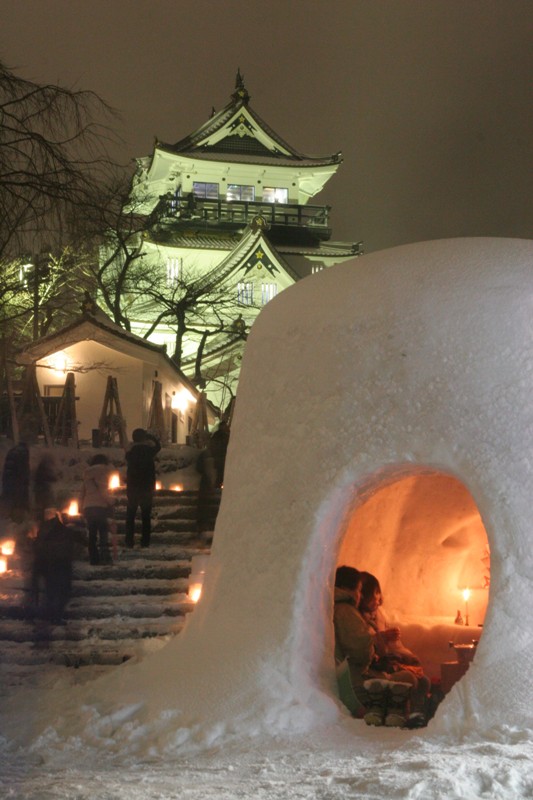
The Yokote Kamakura Festival (横手の雪祭り) has a history of about 400 years. It is held every year on February 15 and 16 in the city of Yokote in southeastern Akita Prefecture. The festival features many igloo-like snow houses, called kamakura, which are built at various locations across the city.

Within each kamakura there is a snow altar dedicated to the water deity, to whom people pray for ample water. A charcoal brazier is set up to provide warmth and grill rice cakes. In the evenings (18:00 to 21:00), children invite festival visitors into their kamakura and offer them rice cakes and amazake, a type of warm sweet rice wine with zero or very low alcohol content. In return, the visitors make an offering to the water deity at the altar.

Along Yokote River, hundreds of small kamakura the size of lanterns are made. These mini kamakura are illuminated by candles from dusk until around 21:00 and create a lovely sea of lights. At the grounds of the Minami Elementary School, more mini kamakura and some snow sculptures are displayed in front of the nice school building. Children can enjoy playing with snow and riding on a snow slide.

Photo:

"Kamakura-yuki" by (社)横手市観光協会 - (社)横手市観光協会. Licensed under CC BY 3.0 via Wikimedia Commons - https://commons.wikimedia.org/wiki/File:Kamakura-yuki.jpg#/media/File:Kamakura-yuki.jpg
Read On >>>

Thursday, March 26, 2015

Hanami (花見)

Hanami (花見,"flower viewing") is the Japanese traditional custom of enjoying the transient beauty of flowers, "flower" in this case almost always meaning cherry blossoms ("sakura") or plum blossoms ("ume").

 From the end of March to early May, sakura bloom all over Japan, and around the first of February on the island of Okinawa. The blossom forecast (桜前線) is announced each year by the weather bureau, and is watched carefully by those planning hanami as the blossoms only last a week or two. In modern-day Japan, hanami mostly consists of having an outdoor party beneath the sakura during daytime or at night. In some contexts the Sino-Japanese term kan'ō (観桜, view-cherry) is used instead, particularly for festivals.

Hanami at night is called yozakura (夜桜). In many places such as Ueno Park temporary paper lanterns are hung for the purpose of yozakura. On the island of Okinawa, decorative electric lanterns are hung in the trees for evening enjoyment, such as on the trees ascending Mt. Yae, near Motobu Town, or at the Nakijin Castle.

Hanami picnics in front of Himeji Castle


Hanami at Maruyama Park behind Yasaka Shrine in Kyoto


Hanami parties along the Kamo River


花見はほとんどの場合、桜や梅の花を意味する。この場合の花、 「花」の過渡美しさを楽しむ日本の伝統的な習慣です。

 月末から月上旬に、桜が咲く日本全国、沖縄の島で2月の最初の周り。花予報は気象庁が毎年発表している、と花が一週間または2続かとしてそれらの計画花見によって注意深く見守っている。現代の日本では、花見は主に昼間や夜間に桜の下の屋外パーティーを構成されています。いくつかの状況では中日用語は、観桜特にお祭りのために、代わりに使用されます。

夜のお花見は夜桜と呼ばれている。そのような上野公園一時的な提灯などの多くの場所では夜桜を目的に掛けられている。沖縄の島では、装飾的な電気の提灯は、そのような富士山昇順木上のように、夜の楽しみのための木に吊るされている八重、本部町の近く、または今帰仁城で。


Read On >>>

Tuesday, March 3, 2015

Hinamatsuri (雛祭り)

Hinamatsuri (雛祭り), also called Doll's Day or Girls' Day, is a special day in Japan. Hinamatsuri is celebrated each year on March 3. Platforms covered with a red carpet are used to display a set of ornamental dolls (雛人形) representing the Emperor, Empress, attendants, and musicians in traditional court dress of the Heian period.

The custom of displaying dolls began during the Heian period. Formerly, people believed the dolls possessed the power to contain bad spirits. Hinamatsuri traces its origins to an ancient Japanese custom called hina-nagashi (雛流し), in which straw hina dolls are set afloat on a boat and sent down a river to the sea, supposedly taking troubles or bad spirits with them.

Families generally start to display the dolls in February and take them down immediately after the festival. Superstition says that leaving the dolls past March 4 will result in a late marriage for the daughter.

Hinamatsuri - Doll set


Hinamatsuri sweets 


また、人形の日や女の子の日と呼ばれるひなまつりは、日本では特別な日です。ひなまつりはレッドカーペットで覆われた3プラットフォームは、平安時代の伝統的な宮廷ドレスで天皇、皇后、客室乗務員、そしてミュージシャンを代表する装飾用の人形のセットを表示するために使用されている月に毎年祝われる。

表示人形の習慣は平安時代に始まった。以前、人々は人形が悪い霊を格納するためのパワーを持っていたと信じていた。ひなまつりはわらひな人形がボートに浮かんで設定し、たぶん彼らとのトラブルか悪い霊を取って、海に川を下る送信されているひな-流し呼ばれる古代の日本の習慣にその起源をトレースします。

家族は一般的に月に人形を表示し、祭りの直後にそれらを取るために始める。迷信は、 3月4日を過ぎて人形を残すことは娘のために晩婚になるとしている。


Read On >>>